Exhibition Text
CoCA Toi Moroki, 1 – 18 June 2024
Ways of Knowing was a two-part exhibition that I co–curated with my fellow Emerging Curator in the inaugural year of CoCA’s Emerging Curator programme. Part I consisted of paintings, Part II contained objects.
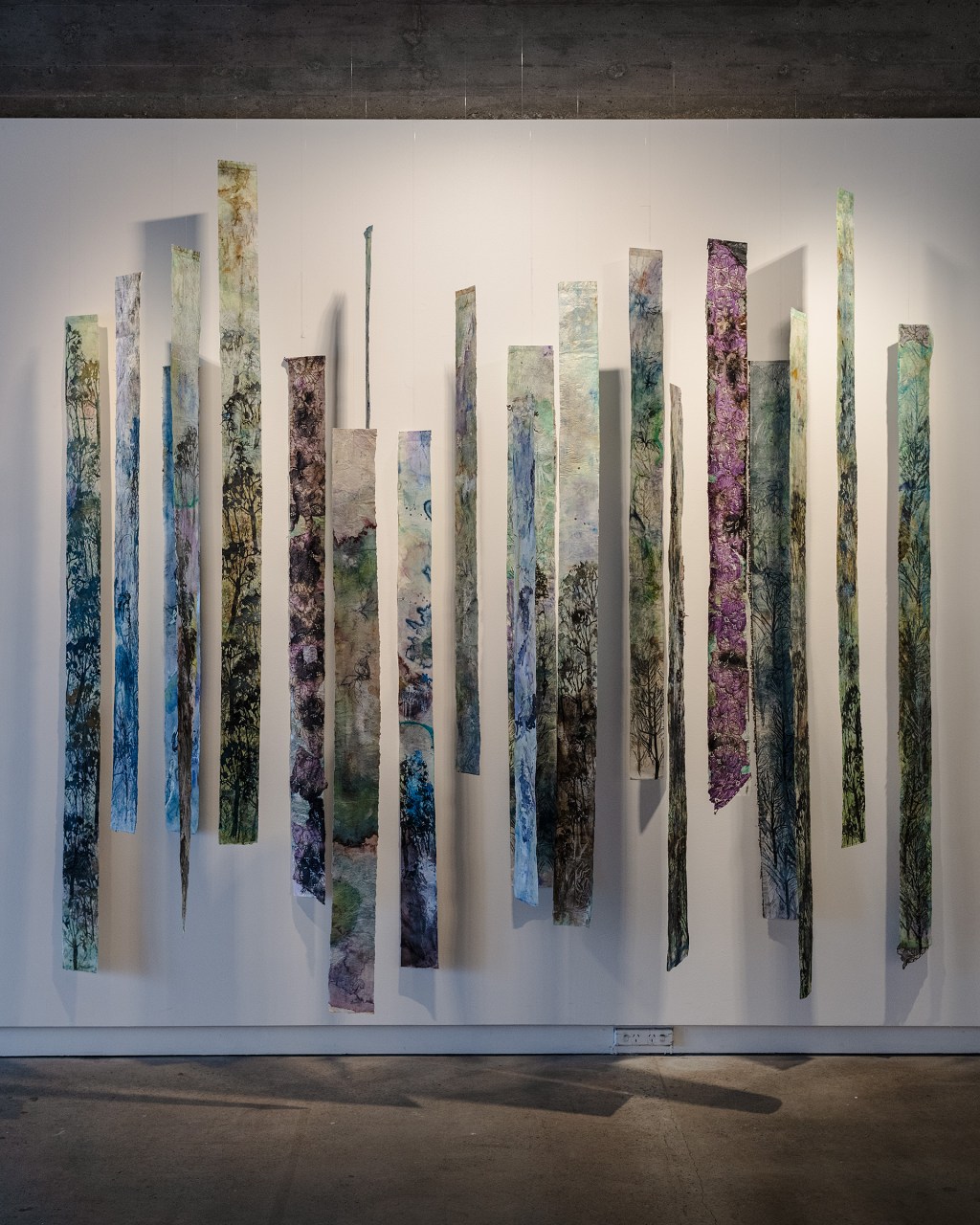
Swaying or dancing outright long strips of layered rice paper hang like a forest of the trees they are painted and printed with. Karen Greenslade’s practice is informed by the environment she lived in for thirty years, at Te Tai Poutini the West Coast. Greenslade researched and witnessed the effects of the gold and coal mining industries in the region and her work Kahikatea Mourning laments the loss of these native trees in the area where she lived. The black and gold alluding to the extractive industries that shaped the green and blues of the forests and waterways. It is a personal, whenua-based way of knowing that she summons.
Next to these hanging ribbons are two domestic scenes, vibrant yet noticeably void of figures. Estefania Mondaca’s diptych generates a different feeling of space to its neighbour. These spaces are intimate in their domesticity and their evocations of family gatherings, but with a title like Shame Wound they feel even closer to the bone. While people do not appear in the field of the paintings, they draw the viewer in to become the inhabitant of these deeply personal realms. These speak to Mondaca’s reckoning of the self, of herself, as cultivated in Chile and Aotearoa New Zealand. At once global and domestic, these works grapple with ways of knowing culturally and privately.
Diving deeper into the liquidity of the subconscious and its dreaming where rules bend to symbolic purpose, Sam Walker’s painting takes you further into this interiority. Like a riptide the twilight toned forms and ghostly figures, clear from a distance, become transparent and then almost disappear when within arm’s reach, pulling you in. Walker’s deftly executed layering gives the impression of fading light in all its sudden purple vibrancy. Materially, this process captures the delicacy of harvesting images from her own dreams and placing them over each other like so many delicious sheets of filo pastry. The visceral renderings of dreaming as a way of knowing holds an almost mythic weight in the way details can seem universal.
Playing with the subconscious and the conscious’ self-awareness, Samantha Allen repeats the image of balloon heads while tenuously tethered to their bodies. These heads, often one-eyed and blushing, sometimes meet each others’ unsettling gaze seemingly to witness the shared awkwardness in sympathy. These heads float above the rest of themselves in the way we often function on autopilot, watching from afar as we continue to operate. They also act as metaphors for the way we think about thinking, the way we think of ourselves, or think ourselves into being. Allen’s figures are not alone because of the way others shape this knowing or can change this thinking, often for the better.
This is a way of valuing the diversification of understanding, of extending beyond yourself to gain further insight. In the vein of an institutional critique, Anita DeSoto challenges what has been canonised by early art academies and histories. In a large-scale deconstruction of an old master’s painting DeSoto rewrites its history, blurring out the male voyeurs to leave the women alone in their recreation. Often treated as allegory, object, or both, the female nude in old master paintings is often stagnant in her lack of agency. DeSoto’s gestural style restores activity and dynamism. This challenge to the canon does not disregard the technical skill of painting, but rather offers nuance to what and how we know and value painting, why, and who made those rules.
This momentum carries through to the painting practice of Ava Trevella whose works are grounded in an intuitive and materially experimental process. In dipping into the poetics of everyday human experiencing she extends this consideration to other animals. Their forms swarm together in her works, traced over varying thicknesses of pigment as if wearing their changefulness in colour. Trevella describes living in ‘vigorous waves of motion’ in all their ‘queasiness and beauty’ and prioritises the mystery and murkiness of these woven emotional fields of awareness. In providing this different way of looking she presents a way of knowing that isn’t hungry for answers and in doing so widens what is up for consideration, and perhaps ultimately reveals more.
Guiding us on this intuitive journey Ferne McIntosh’s guardians join hands to return us to a spiritual awareness brought about through the whenua. Her Scottish and Māori tīpuna inform her relationship within what she calls our circular environments. In turn, this generates her creation of contemporary landscapes populated by a visual language established in her works. Within the circularity of these environments McIntosh sees the intuitive and the natural as spiritual, the whenua as being of body and soul. This way of knowing is a remembering, a recontextualising of the Anthropocene within ways of relating to each other as participants in our environment, a collective consciousness and heart.
 meg doughty