Exhibition Catalogue Essay
Ashburton Art Gallery, 8 March – 27 April 2025
When she first turned to painting gridded forms Agnes Martin thought of trees. Specifically, she thought of their innocence. This association held throughout her career and was the key inspiration for her 1964 painting The Tree. Shy of being a two metre square, the canvas appears as though mist has been captured and confined to neat lines from afar. On closer inspection, lines of charcoal grey can still be seen where she ruled them in pencil. Within this grid, which sections the canvas into a quilt of rectangles, alternating rows are painted in the softest grey to make thick stripes. Nothing too bright, too sharp, everything precise and fine, like the breathing trees themselves had whispered the image to her.
This pale square is not typically how trees or nature more broadly have been rendered in art. Likewise, Marie Porter’s cubing of the woods is not typical— not to look at, at least. But the woods have been sectioned before. Every divet, mound and scrub-lined ridge is visible at one point or another in the afternoon’s shift to dusk in the valley where Wairewa Little River rests. Looking at all the unevenness, sloping and scale, it is hard to think of this whenua being measured out into hectares, acres, or square metreage. Looking again the hills are segmented by tiny fence posts and wire like Martin’s pencilled lines, and are patched with unusually geometric swathes of dark green. The smell of pine sap, the acid distributed by their needly carpet and their dense gatherings are commonplace across Te Pātaka o Rākaihautū Banks Peninsula.
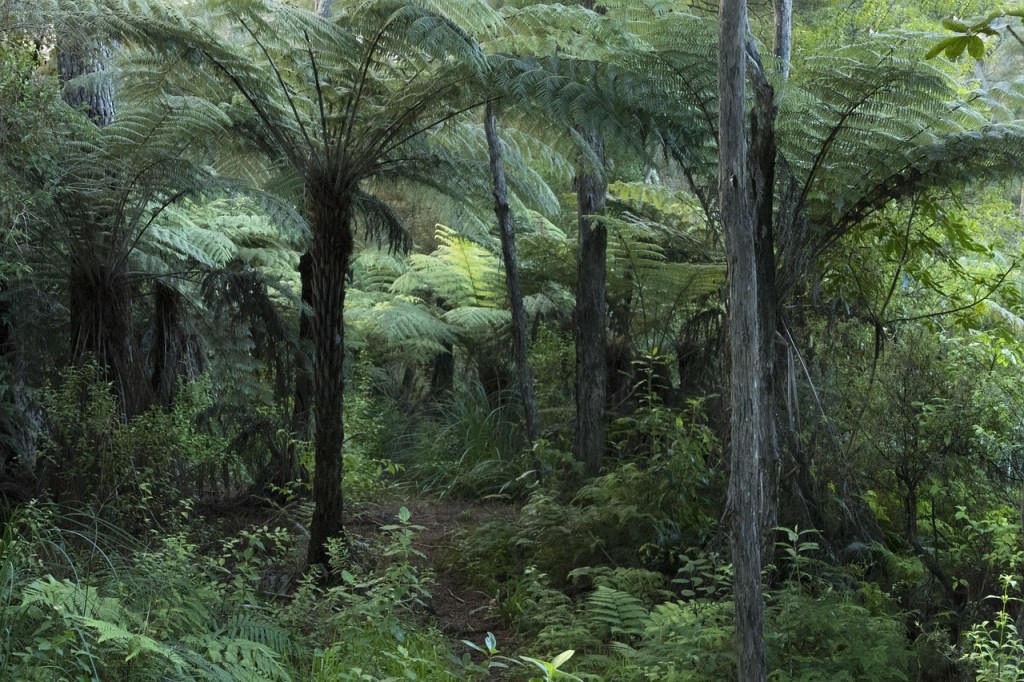
Once famous for its thick native kahere and accompanying birdsong, much of Te Pātaka o Rākaihautū’s cloak was stripped to be milled for establishing the Christchurch settlement. Recloaking is the term that has been given to organised runaka-lead native replanting in the area. In the Okuti Valley Porter sought to commence her and her family’s own recloaking efforts. Porter coordinated with the Reynolds Valley community who agreed that the initial disruption of logging trucks was a small price for the ongoing health of the valley, and the benefit for future generations. Once given the go ahead, large trucks arrived with cubic metres of fuel in plastic tanks, tilling the earth with heavy-treaded tyres as they moved. The arrival of this equipment seemed a strange paradox for an initiative intended to cultivate the return of a native ecology but, as is common in cycles of nature, some destruction must occur before new growth can take root.
Paradox often draws in sculptors and installation artists. Roni Horn and Richard Serra, key influences to Porter, deal in relationships, scale, and problematising environments or architecture that might have otherwise been familiar. They invite you to bring your own physicality to works where they have brought theirs, to meet them there. For these three artists this meeting takes place through the sensing body. With their three-dimensionality, sculptural and installation works ask questions of the audience (or participants) in how they move and therefore how they relate to the art they encounter.
With his sweeping steel forms Serra has described an interest in making “obdurate” objects float, making the heavy light. He focuses on the elasticity of the steel in his sculptures, not typically what people think of when experiencing rigid sheets of metal in a space. He includes this elasticity in the way his forms arc, bend, and peel away from the ground on seemingly impossible organic paths. Similarly, Horn has crafted objects that become less familiar the more time you spend with them. This doubt is the device Horn uses to pull people into that sensing body, to encourage them to engage as they are.
In this particular paradoxical vein, Porter cubes the organic. Like building blocks, units of measurement for space, like the woods have been harvested, filtered, compacted into composite elements, the audience meets nature unexpectedly. Porter’s physicality is evident in the work of gathering, puzzling together, and growing. These stacks are not for building with or burning, but to make cubes from round things, soft things, breathing things. Porter’s paradox-making notes that what may be thought of as “natural” may appear wild, but there is nowhere that is no longer affected by humanity’s long reach. Now, the collective question ringing with hope is what to do with that reach.
*Note: This catalogue was published in print in the exhibition catalogue.
 meg doughty