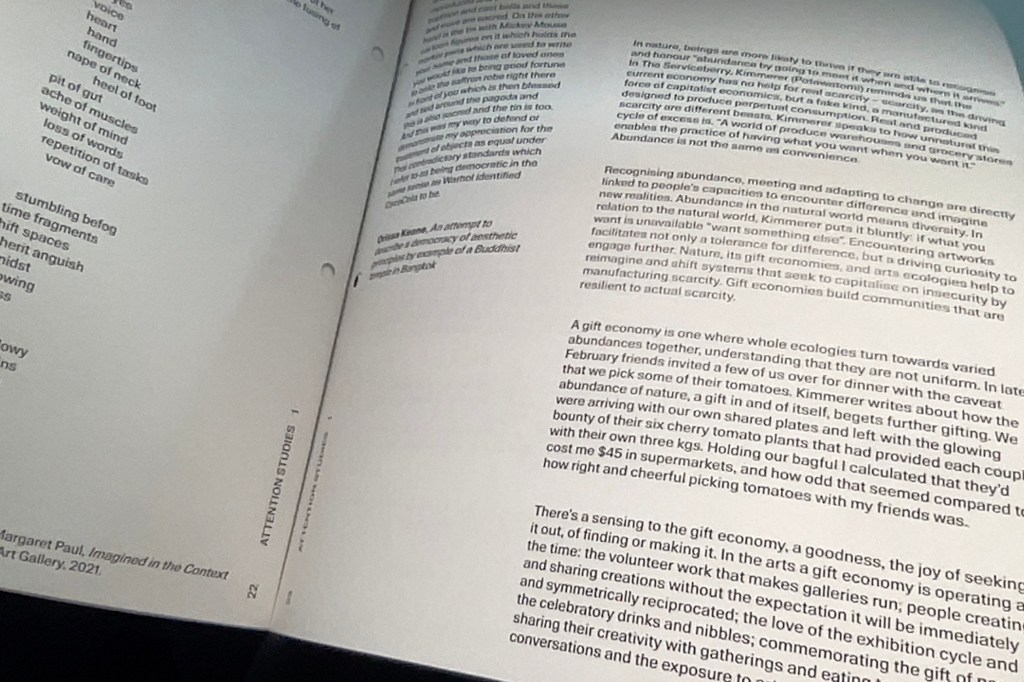
Attention Studies is a Physics Room initiative where a group of creative practitioners were selected to participate in a collaborative environment to produce a year’s worth of serial publications. Here is my contribution to No.1. I’ve also linked the whole issue below so you enjoy the variety of skilled writers!
February 2026
In nature, beings are more likely to thrive if they are able to recognise and honour “abundance by going to meet it when and where it arrives.” In The Serviceberry, Kimmerer (Potawatomi) reminds us that the current economy has no help for real scarcity – scarcity, as the driving force of capitalist economics, but a fake kind, a manufactured kind designed to produce perpetual consumption. Real and produced scarcity are different beasts. Kimmerer speaks to how unnatural this cycle of excess is. “A world of produce warehouses and grocery stores enables the practice of having what you want when you want it.” Abundance is not the same as convenience.
Recognising abundance, meeting and adapting to change are directly linked to people’s capacities to encounter difference and imagine new realities. Abundance in the natural world means diversity. In relation to the natural world, Kimmerer puts it bluntly: if what you want is unavailable “want something else”. Encountering artworks facilitates not only a tolerance for difference, but a driving curiosity to engage further. Nature, its gift economies, and arts ecologies help to reimagine and shift systems that seek to capitalise on insecurity by manufacturing scarcity. Gift economies build communities that are resilient to actual scarcity.
A gift economy is one where whole ecologies turn towards varied abundances together, understanding that they are not uniform. In late February friends invited a few of us over for dinner with the caveat that we pick some of their tomatoes. Kimmerer writes about how the abundance of nature, a gift in and of itself, begets further gifting. We were arriving with our own shared plates and left with the glowing bounty of their six cherry tomato plants that had provided each couple with their own three kgs. Holding our bagful I calculated that they’d cost me $45 in supermarkets, and how odd that seemed compared to how right and cheerful picking tomatoes with my friends was.
There’s a sensing to the gift economy, a goodness, the joy of seeking it out, of finding or making it. In the arts a gift economy is operating all the time: the volunteer work that makes galleries run; people creating and sharing creations without the expectation it will be immediately and symmetrically reciprocated; the love of the exhibition cycle and the celebratory drinks and nibbles; commemorating the gift of people sharing their creativity with gatherings and eating together. The conversations and the exposure to art practices, ways of being, are enlivening. Like heliotropes, it’s beautiful to watch people turning towards the arts in their communities and the communities made through art.
The Serviceberry nourishes. I plucked phrases like tomatoes, putting them in my basket and marvelling at the enoughness and the provision, feeling cared for. The biggest tomato I am taking with me is Kimmerer’s compassion and how it makes hard truths more bearable and wholesome ones sweeter.
Meg Doughty / Robin Wall Kimmerer, The Serviceberry: Abundance and Reciprocity in the Natural World, 2024.
 meg doughty